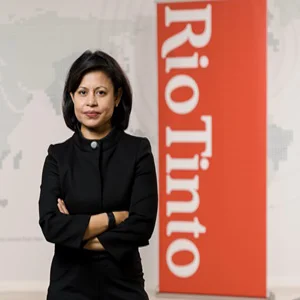
“Rio Tinto is extremely proud of its ability to produce some of the highest quality, lowest-carbon footprint aluminium,” Paramita Das, Head of Metals and Minerals, Marketing and ESG at Rio Tinto
- Category
- Interview
- Date
- 16 February 2023
- Source
- AlCircle.com
Paramita Das is a global executive with extensive experience in the commodities segment (metal, oil and gas). She leads marketing for metals and minerals globally and the establishment of a more ESG-centric approach in the Atlantic region. Prior to her work in the marketing and development space, Paramita was the Chief of Staff to the CEO of Rio Tinto and Chief Transformation Officer for the Atlantic Operations for the company's aluminium segment. Paramita joined Rio Tinto in 2015, before which, she worked with companies including Sumitomo/UACJ/TAA and BP. She is a passionate advocate for ESG and inclusion.
Here is an excerpt from an interview with her on green initiatives undertaken by Rio Tinto.
AlCircle: What is Rio Tinto doing to reduce its carbon footprint?
Paramita Das: Decarbonisation is an urgent priority for the planet—and that includes Rio Tinto.
We set ambitious climate targets to reduce our scope 1 and 2 emissions by 50% by 2030. And, to meet that target, we’ve created six large abatement programmes. They are focused in key areas including renewables, ELYSIS™, process heat, and diesel.
In our aluminium business, we are identifying a pathway to turn our Boyne Smelter (BSL) into the industry’s first large scale aluminium smelter operating fully on solar and wind renewable power. We are in the process of securing 4GW of renewable power to provide a competitive future for our Queensland aluminium and alumina assets.
And, in the process heat space—at our Yarwun alumina refinery—we are working closely with partners like the Australian Renewable Energy Agency (ARENA) and Sumitomo Corporation to study whether renewable hydrogen can be used in alumina refining.
AlCircle: Rio Tinto produces one of the lowest carbon aluminium in the world. What makes this possible?
Paramita Das: Rio Tinto is extremely proud of its ability to produce some of the highest quality, lowest-carbon footprint aluminium. And this is mainly possible thanks to our hydropower operations.
We all know that it takes a lot of energy to produce aluminium. Hence, it’s important to look at how we power our production.
Eighty per cent of Rio Tinto aluminium is produced with green power. In fact, all our smelting capacity in Canada is hydro-powered, and collectively we have just over 4GW of capacity. Our smelters rely on enormous water sheds of several hundred thousand km2. As a result, the greenhouse gas emissions intensity of our managed Atlantic Operations smelters represents less than one-fifth of the industry average.
We continue to look at ways to improve our hydropower operations. In Saguenay, Quebec, and Kemano, British Columbia, we have a programme to both refurbish and lift the capacity of our existing hydro power stations. In 2022, we finalised the Kemano Tunnel 2 project to ensure the long-term, sustainable production of low-carbon aluminium at our smelter in Kitimat. We continue to look at ways to improve our hydropower operations. In Saguenay, Quebec, and Kemano, British Columbia, we have a programme to both refurbish and lift the capacity of our existing hydro power stations. In 2022, we finalised the Kemano Tunnel 2 project to ensure the long-term, sustainable production of low-carbon aluminium at our smelter in Kitimat.
AlCircle: Could you share more about Rio Tinto’s sustainable aluminium journey?
Paramita Das: As an industry leader in responsible aluminium, we’re committed to bringing sustainable aluminium to market.
We launched the industry’s first certified low carbon aluminium, called RenewAL and became the first company to receive certification from the Aluminium Stewardship Initiative (ASI) as producing “responsible” aluminium”.
We are also helping further develop ELYSIS™, a breakthrough smelting technology to produce aluminium with no direct greenhouse gas emissions, which is now being used in Apple products.
And in 2021, we launched START, another pioneering step in our on-going sustainability journey with our customers. Using blockchain technology, START works like a ‘nutrition label’ for aluminium – providing transparency and traceability across our supply chain, so end users can see environmental, social, and governance information across 14 areas including carbon footprint, water use, and recycled content.
AlCircle: Aluminium, like other critical minerals such as nickel, lithium, and cobalt, is key to the clean transition ahead of us. How is Rio Tinto helping the world move towards this transition?
Paramita Das: Rio Tinto is finding better ways to provide the materials the world needs. Our focus is to produce them in a sustainable way while avoiding harm and mitigating impacts to the people and the planet.
We work closely with our customers and their customers downstream to decarbonise the entire value chain.
In 2022, we formed a partnership with Ford to develop more sustainable and secure supply chains for battery and low-carbon materials for Ford vehicles including lithium, low-carbon aluminium, and copper.
And, with Volvo Group, our partnership covers multi-commodity supply for their green transition. As a customer of their trucks, we also collaborate on developing small, autonomous electric vehicle technology for our operations.
AlCircle: How is Rio Tinto using new technologies in its drive towards green initiatives?
Paramita Das: We use breakthrough technologies to produce sustainably made materials, in some cases without additional mining, thus maximizing the full value of our resources.
In our aluminium business, ELYSIS™ zero-carbon aluminium smelting continues to be an exciting development. The process eliminates all direct greenhouse gases from aluminium smelting and instead produces oxygen. The ELYSIS™ R&D is progressing well with work and is now focused on scaling up the technology for even larger commercial-size cells, which should become operational in 2023.
At RTFT in Quebec, we became the first producer of scandium oxide in North America by using an innovative process we developed to extract high-purity scandium oxide from waste streams without the need for any additional mining. Scandium is an essential material in Al-Sc alloys in automotive and aerospace applications and will be a critical ingredient for net zero product applications.
Another example is carbon mineralisation. In February, the US Department of Energy’s ARPA-E Innovation Challenge awarded $2.2 million of funding to a Rio Tinto-led team that is exploring carbon storage potential at the Tamarack nickel joint venture in central Minnesota. We are also contributing $4 million to the 3-year project.
Carbon mineralisation uses natural chemical reactions to convert captured carbon dioxide into rock and permanently store it underground. It has the potential to be an important technology in meeting global climate goals.
AlCircle: Speaking of technologies, can you tell us how Rio Tinto's first sustainability label based on blockchain for aluminium, START, is performing? How have customers responded?
Paramita Das: In a 2022 pilot with ABInBev, we launched a specially-marked Corona beverage can in Canada. The cans had the lowest CO2 footprint in the world – made from Rio Tinto aluminium, including ELYSIS™.
In this pilot, the cans included a consumer QR code. Scanning the code took users to a web page to learn more about the cans’ low carbon footprint.
This ground breaking pilot is the next step towards putting a fully traceable beverage can in the hands of consumers.
Since START was launched in 2021, we have received overwhelmingly positive support from our customers. The high level of interest further corroborates the demand for traceability, provenance, and sustainability in the industry. Sustainability is a team sport, and we’ll need more like-minded partners to come and work together with us.
AlCircle: What message would you like to share with the global aluminium industry as part of Rio Tinto's commitment to a sustainable future?
Paramita Das: For 150 years we’ve faced challenges, found solutions, celebrated our successes, and learned from our failures. With a new era, we face new challenges, and the one facing us right now is climate change.
Climate change is an unprecedented challenge, and a key topic for the metals and mining sector.
We have put impeccable ESG at the heart of our approach and decision-making. This means pursuing our own decarbonisation with conviction, while helping our customers develop low-carbon products and services with a focus on partnerships at all levels to solve challenges together.
